
Agent Washing
A vendor relabelling an existing chatbot or automation tool as an AI agent without adding any new capability. The phrase was coined by industry analysts for products rebranded as agentic on the strength of the label alone.
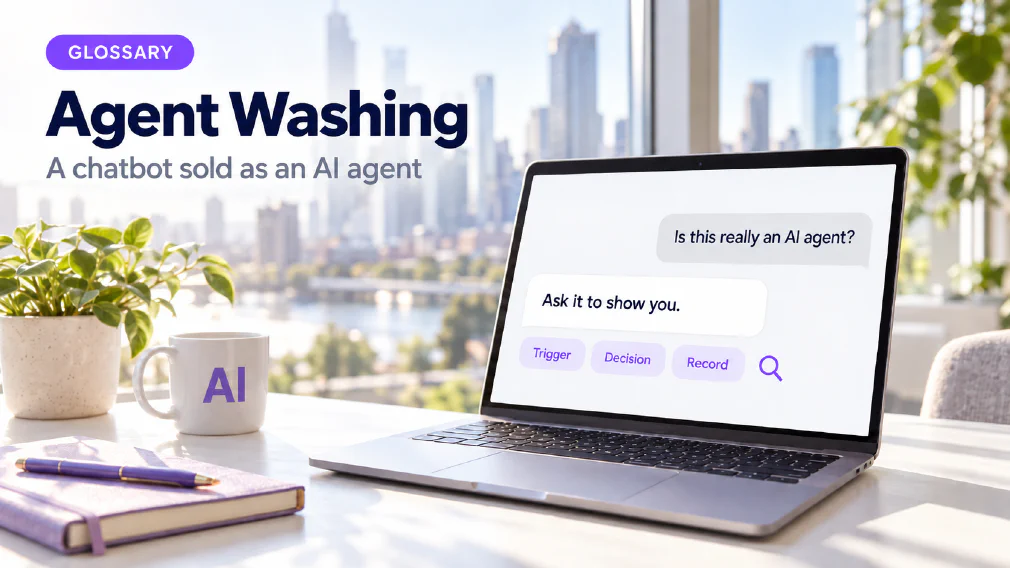
What Agent Washing means
Agent washing is a vendor relabelling an existing chatbot or automation tool as an AI agent without adding any new capability. The product on the screen is the same one that was sold last year. What has changed is the word on the box.
The phrase matters because the word it borrows is a real one. An agent, in the sense the site uses, is a system where the model chooses its own steps and tools as it goes. That is a specific design with specific costs. A product that carries the label without the design gives a buyer the cost of believing in it and none of the capability. The label alone says almost nothing, which is why this page is about behaviour you can watch and not claims you can read.
Why the phrase exists
The workflow article reports an analyst forecast published in June 2025, based on a poll of more than 3,400 organisations investing in the technology. It predicted that more than 40% of agentic AI projects would be cancelled by the end of 2027. The same analysts coined the phrase, and estimated that only about 130 of the thousands of vendors making the claim were building something that deserved it. Their own summary of why projects fail was that most are early-stage experiments, driven by hype and often misapplied.
Those are the analysts’ figures, quoted as the article states them, and they are a forecast and an estimate, not a count. What they establish is that the confusion is not a failure of buyer intelligence. It is built into how the product category is being sold. A buyer who can only judge a product by its label will lose, so the useful move is to go from labels to behaviour.
What actually differs under the label
The cleanest way to see the difference is to ask who controls the path. In a chatbot, the person controls it: they decide what to ask next, and the system answers each turn on its own. In a workflow, the designer controls it: the steps, the order and the hand-offs were decided when it was built, and the model works inside them. In an agent, the model controls much more of it, deciding at run time which tool to use and when it is finished.
The article draws the line the way one major AI lab’s engineering guide does. A workflow is a system where a model and tools are orchestrated along a path written in advance. An agent is a system where the model directs its own process and tool use. The same guide advises finding the simplest solution that works and adding complexity only when needed, because an agent brings higher cost, higher latency and errors that can compound across steps. Agent washing sells that complexity’s name without the complexity, or sells the complexity to a buyer whose process did not need it.
There is a middle ground, and most useful business systems sit in it. An agentic workflow is a fixed path you control, with a model handling the individual steps that need judgement. A published four-level model of AI automation describes the ladder as chatbots, then automated workflows, then agentic workflows, then coordinated multi-agent systems. It observes that most businesses using AI today are at the first or second level. That is not a criticism. The second level is where most of the dependable value is, and a team that jumps past it usually inherits the new risks without the reliability that made it worth having.
Five tests that expose it
Descriptions of capability are cheap and behaviour is expensive to fake. The article’s five tests each ask for behaviour, and each can be run in a vendor demonstration, a pilot review or an internal build check. A real workflow passes all five without drama. A chatbot with extra steps stalls on at least two.
- What starts it? Ask to see the moment the work begins without anyone typing. A real system answers with an event: a form submitted, an email arriving in a mailbox, a record created, a schedule firing. If a person opens the tool and asks, it is a chatbot, which is fine as long as it is bought and judged as one.
- Where does the result land? Ask to see the output arrive in the system your team already works in, with no copying. The simplest version is to watch for the clipboard. If a person selects the reply and pastes it elsewhere, the last and most valuable step is still manual.
- Where does a decision happen? Ask to see one specific moment where the system chooses between valid options on the strength of context, not just the next step in a fixed list. For a deliberately fixed path the honest answer can be that nothing branches. What fails is a claim of autonomy with no choice to point to.
- What happens when it goes wrong? Ask for the failure path: a malformed input, low confidence, a connected system that is down, a case the system was not built for. The right answer names an owner, a queue or a notification, and says whether the action is reversed or held. See exception handling.
- What is the record? Ask what is kept after a run: the input, what the model returned, what was approved and by whom, and what changed downstream. A chatbot keeps a transcript, which shows what was said and not what was done. See audit trail.
Score it honestly. Five passes is a real workflow. Three or four with a clear plan for the rest is a promising one. Two or fewer, and the product is a chatbot with extra steps, which may still be worth having if it is sold and measured as one.
Two more questions when actions are hard to undo
If the system can send messages, change records or move money, the article adds two questions. The first is what level of human oversight is built in, meaning where a human in the loop has to approve, and whether that is a deliberate design decision or a limitation nobody has mentioned. The second is whether the system is running with real autonomy at a live customer today, and not in a sandbox built for demonstrations. Vendors with real production experience answer both quickly. Others reach for the roadmap.
When a Chatbot is the Honest Answer
Agent washing is not an argument against chatbots. A chatbot is the right tool when the job is a conversation: answering common questions, surfacing documentation, taking a first pass at an enquiry or pointing someone to the right team. It is quick to deploy, needs few integrations and is easy to explain to staff.
The mistake is buying a chatbot for a process. The telltale sign is the hand-off. If your team uses the chatbot and then re-types, re-formats or re-files what it said, the chatbot has produced a draft and a person is still doing the process. That is augmentation, and it can be valuable, but it should be named as that and measured as that. Counting it as automation, then wondering why the hours never came back, is how projects end up among the cancelled.
A chatbot can also be the front door to a workflow. A person asks for something in conversation, and the system turns the request into a triggered run with its own steps, checks and record. The experience stays easy for staff while the real work sits somewhere it can be controlled.
When an Agent is the wrong Answer too
The reverse mistake is as common. If a process is stable and you can draw it as a flowchart, an agent adds unpredictability to a problem that had none. It will be slower, harder to debug and more expensive to run than a fixed path with a model at the two or three steps that need language or judgement. Reserve agents for open-ended work where you cannot predict how many steps are needed, and keep a person reviewing anything consequential.
That is why a vendor who says “agent” is not automatically offering more. Often the honest, better product is a workflow, and the honest vendor says so. The task against decision article covers where a model should be allowed to choose and where it should not, and the well-scoped workflow article covers what a process needs before anything is built.
A worked example
This is an illustration, not a real client or product. A small firm is shown two tools that both claim to automate supplier invoices. In the first demo, a person opens the tool, pastes in an invoice and receives the supplier, amount and due date. The person then copies those into the finance system and tells the approver. That product fails the first two tests, and it is a chatbot, however many steps appear on the slide.
In the second demo, the invoice reaches a shared mailbox and starts the run. The model extracts the details, a check flags anything unusual and sends it to a named person, and clean invoices are written to the finance system and logged. Asked about the failure path, the vendor shows the queue a malformed invoice lands in and who is notified. Asked about a decision, the vendor says the path does not branch and the model only extracts within each step. That is a fixed workflow, honestly described, and it passes all five tests without calling itself an agent.
Mix-ups worth avoiding
Four confusions come up often enough to name. The first is treating every agentic claim as false. The test is behaviour, and a product that passes it has earned its description. The second is treating a chatbot as a lesser product. It is the right tool for a conversation, and the fault lies with the buyer who expects it to finish a process. The third is assuming a longer feature list proves capability. Steps in a marketing diagram say nothing about who owns the trigger, the failure path or the record.
The fourth is assuming the label settles accountability. Whatever the product is called, a named person in the business still owns what it does. The ownership questions sit in AI governance and do not change with the vocabulary.
Where it goes wrong
One failure is judging a demo by how good the conversation sounds. A fluent answer to a question tests the language model and not the process around it. Another is accepting a description in place of a demonstration: a vendor who explains how the system would handle a failure has not shown it handling one.
A third is skipping the failure path because the demo data was clean. Real invoices, tickets and applications arrive malformed, and the system has to be judged on those. The last is spending on an agent for a process that needed a flowchart, then discovering the cost, delay and unpredictability the engineering guide warned about.
Where it appears in an Audit
Agent washing is something an audit tends to bring into view, because the audit maps what is actually in use and what each tool actually does, not what it is called. A product sold as an agent that turns out to be a chatbot with a copy-and-paste step shows up as a process still done by hand. That finding is more useful than the label, because it shows where a real workflow would pay off.
If you want a second pair of eyes on a specific process or a vendor’s claims, a discovery call is the quickest way to find out which of your processes deserve a real workflow and which are better served by a chatbot kept in its lane.
Sources
- How to tell a real AI workflow from a chatbot in disguise: the definition of agent washing, the June 2025 forecast, the poll of more than 3,400 organisations, the 40% cancellation forecast, the estimate of about 130 genuine vendors, the five tests, the two extra questions for actions that are hard to undo, the four-level ladder and the chatbot as the front door to a workflow.
- The difference between automating a task and automating a decision: where a model should be allowed to choose.
- What a well-scoped AI workflow needs: what a process needs before it is built.
- How we audit: the mapping of what is in use.
FAQ
Questions about Agent Washing
What is Agent Washing?
The workflow article defines it as a vendor relabelling an existing chatbot or automation tool as an AI agent without adding any new capability. It reports that the analysts who coined the phrase estimated that only about 130 of the thousands of vendors claiming agentic AI were building something that earned the name.
AI AgentHow to tell a Real AI Workflow from a Chatbot in disguise
How do I spot Agent Washing in a Demo?
Ask for behaviour, not a description. The workflow article's five tests ask what starts the system, where the result lands, where a decision is made, what happens when it goes wrong and what is recorded. A real workflow passes all five. A chatbot with extra steps stalls on at least two.
Who coined the phrase and why?
The article says the same analysts who forecast that more than 40% of agentic AI projects would be cancelled by the end of 2027 coined it, for vendors who rebrand existing chatbots and automation tools as agentic. The forecast, published in June 2025, drew on a poll of more than 3,400 organisations.
Is every product sold as an Agent a fake?
No. The article does not say that, and neither does this page. It says the label tells you almost nothing, and that the way to find out is to watch the product make a decision and handle a failure. Some products do earn the name. The test is behaviour, and it works on any product.
What is the difference between an Agent and a Workflow?
The article uses a widely cited definition from one major AI lab's engineering guide. A workflow runs a model and tools along a path written in advance. An agent lets the model choose its own path and tools as it goes. Most business processes are stable enough for the first.
When is a Chatbot the Right Answer?
When the job really is a conversation, such as answering common questions, surfacing documentation or routing a request. It becomes the wrong answer when someone keeps copying its output into another system by hand. That copying step is the work the chatbot was bought to remove.
What should I ask if the vendor says the product is autonomous?
Ask to see one specific moment where the system chooses between valid options on the strength of context. Then ask what happens when an input is malformed or falls outside what it was built for. A vague answer about the model being very accurate counts as a failed test.
Does a fixed Workflow count as Agent Washing?
Not if it is sold as a workflow. The article says that for a deliberately fixed path the honest answer can be that nothing branches and the model only classifies or drafts inside each step. What fails is claiming autonomy and being unable to point to the choice being made.
What it means for a Business
The label on a product says almost nothing about what it does. The defence is to ask for behaviour rather than a description: a live demonstration of a decision the system makes, and of what happens when a case goes wrong.
Ready to Put This to Work?
Tell us where your team is with AI and we will tell you honestly what would make the biggest difference.