
Candidate Shortlisting
Using AI to rank or filter job applicants so that a person can decide who goes forward. The site places it at the Recommend rung of the delegation ladder, with a person accountable for the final call.
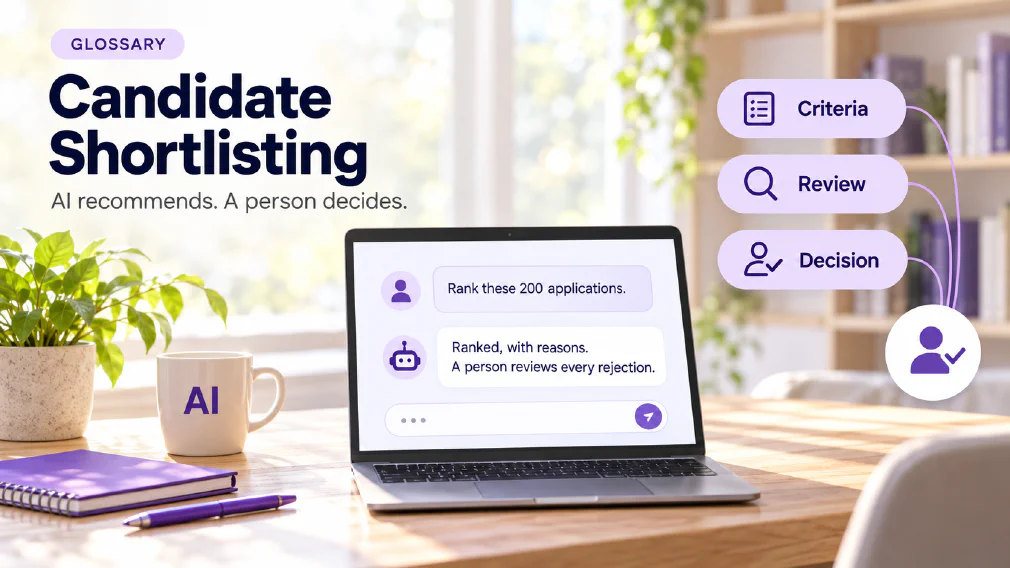
What candidate shortlisting is
Candidate shortlisting is using AI to rank or filter job applicants so that a person can decide who goes forward. The site places it at the Recommend rung of the delegation ladder, with a person accountable for the final call.
It is one of the clearest examples on the site of work that looks like a simple sorting job and is not. A tool reads a pile of applications and returns an order. The order is useful. It is also a decision about people, made on criteria that are never perfectly fixed in advance, and that is why it sits where it does.
This page uses that meaning. It reports what the site’s own articles say about accuracy, bias and the law, and it is not legal advice. Where a legal duty is mentioned, the site’s review says to take advice on the high-risk cases, and so does this page.
Why shortlisting stops at Recommend
The task and decision article sorts every step onto a four-level ladder: Assist, Recommend, Execute or Never delegate. It compares two jobs that look alike. A password reset and a candidate shortlist are both, in a narrow sense, deciding something about a request.
The reset is reversible in seconds, happens thousands of times a day and is governed by a rule with no ambiguity in it. Candidate shortlisting happens far less often, is much harder to undo once a candidate has been told no, and is judged against criteria that are never perfectly fixed in advance. Run both through the same test and the reset climbs to Execute while the shortlist stops at Recommend, because it scores high enough on consequence and ambiguity that a person has to stay accountable for the final call, however good the AI’s ranking is underneath it.
The article adds why this matters in practice. Sorting a process onto the ladder before anything is built means shortlisting-type steps get scoped as Recommend from day one, with a named reviewer built into the process, instead of drifting towards Execute later because nobody revisited the original design once the tool proved itself on the easy cases. The delegation ladder page sets out the test.
How Accurate is AI at shortlisting?
The article reports figures for this. On structured, data-rich predictions such as candidate shortlisting, it says AI reaches about 75 to 80% accuracy against 85 to 90% for experienced humans doing the same job. These are the article’s figures and not the site’s own measurement.
It reads them carefully. The gap is close enough for the AI’s output to be genuinely useful as a second opinion, ranking or flagging cases for a person to look at first. It is not close enough to hand the call over and stop checking it, and the article says treating a 75 to 80% system as though it clears the same bar as an 85 to 90% one is where confidence outruns the evidence.
The accuracy gap page covers the idea more widely. Its point is that the gap is a reason to sort each step by how much authority to hand over, not a reason to distrust automation.
Filtering against criteria or ranking by a score
The HR training article draws a line that is easy to miss. Filtering candidates against published criteria is an arguable use of AI. Ranking them by an opaque score is not.
The difference is that a published criterion can be explained and challenged, while an opaque score cannot. The article’s practical fixes follow from that: check, do not rank; quote the line a decision rests on; report a finding, not a judgement; name a published criterion for every exclusion; and anonymise the data locally. It also recommends keeping the final call with a person, not the model.
This is why a screening step needs a reason on the record for every candidate it screens out. A bare score tells nobody what to correct, and it leaves the person at the end of the process with nothing to check.
Why shortlisting is High-Risk under the EU AI Act
The site’s review of the EU AI Act and GDPR says the Act treats AI used in recruitment and candidate evaluation as high-risk, including CV filtering and job-advert targeting. It adds that if you use an AI tool to rank applicants, you are in the high-risk group whichever product you use, and you should take advice before continuing.
The key idea is that the Act classifies the use, not the tool. The EU AI Act article gives an example. A chat assistant that drafts a job advert is minimal risk. The same assistant asked to rank 200 CVs and produce a shortlist is a use in the employment area, and the article says to treat it as high-risk from the day it starts to influence who gets an interview.
The review also reports the timing. The Digital Omnibus moved the date for stand-alone high-risk systems under Annex III, which includes employment and recruitment uses, from 2 August 2026 to 2 December 2027. Dates are not a reason to wait to decide who is accountable. The high-risk AI system and recruitment AI pages cover the class, and the deployer page covers the employer’s own duties.
The EU AI Act article warns about one common route into a heavy obligation. You take a general chatbot, give it instructions and a folder of CVs and ask it to score candidates. The vendor never intended its product for that, you have changed its purpose into an employment use, and you may now hold the obligations for risk management, documentation and testing. Its simple response is a rule in your policy: no general tool is used for hiring unless the vendor documents the system for that use and the business has taken advice.
How Bias can enter a screening step
A screening tool can shut out qualified people without anyone intending it. The recruiting article says a tool trained on past hiring data can repeat the patterns in it. The AI bias page defines the problem as systematically unfair results, such as screening out qualified candidates.
The HR training article reports survey figures that show why it matters. Half of companies now cite AI introducing bias as a top concern in hiring, and 57% cite AI screening out qualified candidates as a separate top concern. Set against that, 80% of HR professionals still believe AI reduces unconscious bias at the early screening stage. The article’s point is that both are true at once inside the same organisations, so a session or a process that teaches the tool without naming the contradiction leaves the belief in place and the concern unaddressed. These are the article’s reported figures, not the site’s own.
Does GDPR allow Automated Decisions about candidates?
The recruiting article answers this in its FAQ, and it is careful about it. In the EU, it says, AI that screens or ranks applicants is classed as high-risk under the AI Act, and the GDPR gives people the right not to be subject to a decision based solely on automated processing. In practice, it says, AI can sort and summarise applications, and a person should make the decision to reject or progress a candidate.
Two practical points follow. The article says the GDPR already requires you to tell people how their personal data is used, and that telling applicants now, in your job advert or privacy notice, is simple and avoids a problem later. And it warns against pasting candidates’ CVs or personal details into a general chat assistant, because that is personal data and the provider’s terms decide what happens to it. The data protection page covers what applies.
How to test a Tool before you rely on it
The recruiting article gives a test you can run yourself. Run the tool on one role alongside your normal process, with automatic rejection switched off. Compare its ranking with the one a person would have made. Read the reasons it gives for each candidate.
Then run a swap test. Take a handful of real past applications and change details that should not matter, such as the name or the dates that reveal age. Run them through the tool again. If the score moves, find out why before you rely on it, and ask the vendor to explain. Look at who the tool screens out as well as who it ranks highly. Keep notes on what you find, because the article says they double as your record.
What a person must still decide
The recruiting article sets the line between what AI can prepare and what a person decides. AI can draft the job advert, sort and summarise applications, and schedule and update candidates. A person sets the criteria, reviews every rejection, judges the interview and makes the offer.
The rule behind the line is simple. Use AI for the work that is repetitive and low-stakes, and keep a person on anything that decides someone’s chances. The article advises keeping a person in charge of every rejection, and warns against a tool that automatically routes candidates out without one. The human in the loop page makes the same point: a rule that says a person should check is a hope, not a control, so the checkpoint has to be staffed.
What shortlisting does not change
AI shortlisting does not remove the employer’s duties. The site’s pages say the high-risk classification attaches to the use whichever supplier or platform runs it, so a vendor handling compliance is not an answer on its own.
It does not make the ranking fair. A ranking can be faster and still shut out qualified people, which is why the swap test and the check on who is screened out matter.
And it does not remove the person. Every route on this page ends with a person who is accountable for the final call, and a named reviewer who looks at every rejection.
A worked example
An illustration, not a case study, and not advice. A small business has 200 applications for one role.
The hiring manager sets the criteria first and publishes them in the advert. The business tells applicants in its privacy notice how their data is used. A tool reads each application, pulls out facts such as job titles, skills and dates, and compares them with the criteria. CVs are anonymised before they reach the tool, and nothing is pasted into a general chat assistant. Automatic rejection is off.
For the first role, the business runs the tool alongside its normal process. A person makes their own shortlist as well, and the two are compared. A swap test changes the name and the dates on a handful of past applications, and the scores are checked for movement. The notes are kept.
A named person reviews every rejection and the reason given for it. The interviews and the offer stay with people. Because shortlisting is a high-risk use under the EU AI Act, the business takes advice before relying on the tool for real.
Mix-ups worth avoiding
Four confusions come up often enough to name. The first is treating a ranking as a decision, when the site places shortlisting at Recommend with a person accountable. The second is treating filtering and ranking as the same thing, when a published criterion can be explained and an opaque score cannot. The third is assuming the tool, not the use, decides whether the Act applies. The fourth is trusting a vendor’s claim of fairness without testing it on your own applications.
How we use it
The task and decision article says an audit should scope shortlisting-type steps as Recommend from day one, with a named reviewer built into the process. How we audit is where that sorting happens, and the AI bias page covers why a screening step needs a published criterion for every exclusion.
If you want to know where a person must stay in a hiring process you already run, a discovery call is a quick way to start.
Sources
- The difference between automating a task and automating a decision: shortlisting at Recommend, the password reset comparison, the accuracy figures, and scoping shortlisting steps with a named reviewer from day one.
- AI training for HR teams: what should it cover?: filtering against published criteria against ranking by an opaque score, the practical fixes, high-risk classification, and the survey figures on bias concerns.
- EU AI Act vs GDPR: ranking applicants putting a business in the high-risk group whichever product it uses, taking advice before continuing, the use and not the tool being classified, and the Annex III date.
- What the EU AI Act requires of a small business: a drafting assistant being minimal risk and a CV-ranking one being an employment use, and the rule against general tools for hiring.
- Best AI for recruiting: what AI can prepare and what a person decides, the swap test, running alongside the normal process, the GDPR right on automated decisions, telling applicants and keeping records.
- Accuracy gap, AI bias, High-risk AI system, Recruitment AI, Human in the loop, Delegation ladder, Data protection and Deployer: the neighbouring terms this page links to.
FAQ
Questions about Candidate Shortlisting
What is candidate shortlisting?
Using AI to rank or filter job applicants so that a person can decide who goes forward. The site places it at the Recommend rung of the delegation ladder, with a person accountable for the final call. It is also a high-risk use under the EU AI Act, so the site's review advises taking advice before using AI to rank applicants.
Can AI shortlist job candidates on its own?
The task and decision article says no. It reports AI accuracy of about 75 to 80% on candidate shortlisting against 85 to 90% for experienced humans, useful as a ranking for a person to look at first but not enough to hand the call over. Shortlisting stops at Recommend on the ladder, with a person accountable.
Is filtering CVs against criteria the same as ranking candidates?
No. The HR training article says filtering candidates against published criteria is an arguable use of AI, while ranking them by an opaque score is not. It recommends naming a published criterion for every exclusion, anonymising the data and keeping the final call with a person, not the model.
Is AI shortlisting High-Risk under the EU AI Act?
The site's review says the Act treats AI used in recruitment and candidate evaluation as high-risk, including CV filtering and job-advert targeting, and that using an AI tool to rank applicants puts a business in the high-risk group whichever product it uses. It advises taking advice before continuing. The Act classifies the use, not the tool.
How Accurate is AI at shortlisting candidates?
The task and decision article reports about 75 to 80% for AI against 85 to 90% for experienced humans on a call like candidate shortlisting. It says that is close enough for the AI's output to be useful as a second opinion, ranking or flagging cases for a person to look at first, but not close enough to stop checking it. The figures are the article's, not the site's own measurement.
Can AI hiring Tools be biased?
Yes. The recruiting article says a tool trained on past hiring data can repeat the patterns in it. Its advice is practical: ask how a vendor tests for bias, look at who the tool screens out as well as who it ranks highly, compare its shortlists with the ones a person would have made, and keep records.
How can I test an AI hiring Tool?
The recruiting article suggests running it on one role alongside your normal process, with automatic rejection switched off. Compare its ranking with a person's, read the reasons it gives, and run a swap test: change a detail that should not matter, such as a name, and see whether the score moves. Keep notes, because they double as your record.
Which hiring Decisions need a person?
The recruiting article says AI can prepare the work, such as drafting the advert, sorting and summarising applications and scheduling, while a person sets the criteria, reviews every rejection, judges the interview and makes the offer. Use AI for the repetitive, low-stakes work and keep a person on anything that decides someone's chances.
What it means for a Business
The site's task and decision article reports AI accuracy on shortlisting at about 75 to 80% against 85 to 90% for experienced humans, close enough to support the call but not to replace it. The EU AI Act treats CV filtering and candidate scoring as high-risk, so the site's review advises taking advice before using AI to rank applicants.
Ready to Put This to Work?
Tell us where your team is with AI and we will tell you honestly what would make the biggest difference.