
Off the Shelf AI Tool
A general-purpose AI product built for many businesses at once and bought as a subscription, as opposed to a custom workflow built against one organisation's own process. It suits a process shared across most businesses in a sector.
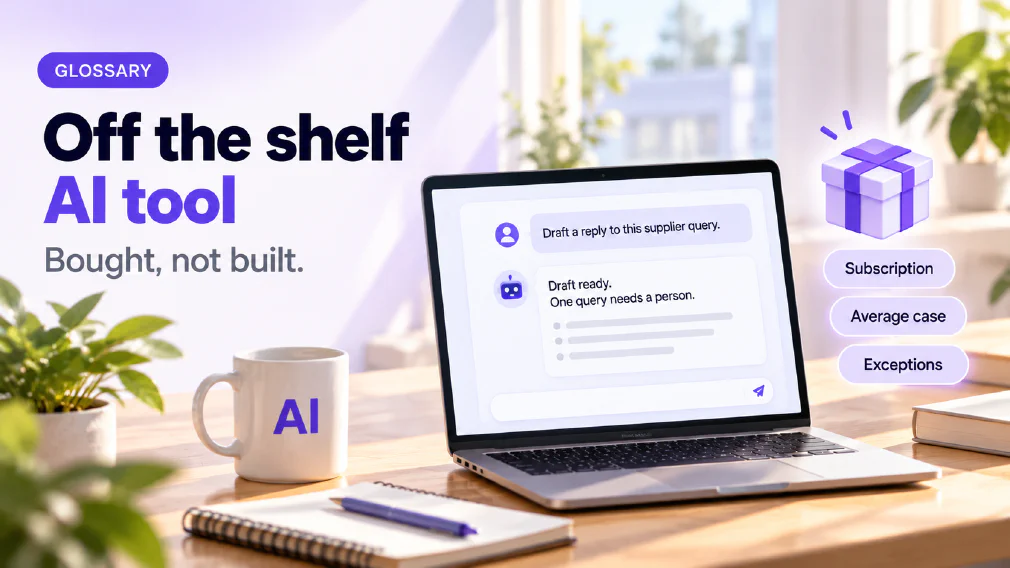
What an Off-the-Shelf AI Tool is
An off-the-shelf AI tool is a general-purpose AI product built for many businesses at once and bought as a subscription. It is the opposite of a custom workflow, which is built against one organisation’s own process. It suits a process shared across most businesses in a sector.
The site’s off-the-shelf and custom comparison describes it in plain terms. It is built once and sold to many businesses in the same form: a subscription, a fixed set of features, and an interface designed for the average user of that category and not for any one organisation.
This page covers what that means for a business in practice: what the subscription price leaves out, when the approach fits, when a custom AI workflow fits better, how to test the choice, and why the process is mapped before either is bought or built.
Built for the average case
The comparison names the strength and the limit of an off-the-shelf tool in the same sentence. It is fast to start, because nothing has to be built first. It improves on the vendor’s schedule and not the customer’s. And its limitation is the same as its strength: it was designed for the average case.
For a process that looks much like everyone else’s, that is exactly what is wanted. Drafting, scheduling, first-pass research and formatting are the review’s examples. The tool has already been shaped by many businesses doing something similar, and a team can start using it without designing anything.
The trouble arrives with the exception. A process with real exceptions eventually runs into ones the tool was never built to handle. The comparison says an off-the-shelf tool generally routes them back to a person. That is the point the site’s definition makes when it says the steps start being done by hand around the tool. The exception handling page covers what a workflow should do when a case falls outside what it was built for, and a general product is the place where that question most often goes unanswered.
What the subscription price leaves out
A subscription’s price is the easiest number to compare and the least complete. The comparison lists what sits outside it: the manual steps still done by hand wherever the tool does not fit the process, the licences renewed for capability nobody is using, and the staff time spent working around a tool and not with it.
None of that shows on the invoice, and all of it is real spend against the business’s own time. The total cost of ownership page sets out the idea: a lower subscription price and a lower total cost are different claims, and only one of them is usually checked before signing up.
A related point comes from the site’s article on running costs. It says the AI model is the smallest line in a workflow’s running cost, and that human review, maintenance and governance add up beside it. A subscription covers some of those and not others, so asking what it covers is a better question than asking what it costs.
The cost shape against a Custom build
The comparison says the two options have opposite cost shapes. An off-the-shelf subscription is ongoing and roughly flat, whatever the use. A custom workflow costs more to start, because nothing exists until it is designed and built, and costs less to keep running once volume is high and the process is stable.
Where the two lines cross depends on volume and on how stable the process is. That is why the comparison says either option can turn into unused spend if it is set against the wrong process. A subscription running against a process too irregular for it to fit is one example. A build sized for volume that never arrives is the other.
The no-code automation page covers a third route that sits between the two, assembling a workflow from pre-built connectors. Its cost grows with every run, which is a different shape again.
When Off-the-Shelf fits
The comparison says an off-the-shelf tool suits a process that looks the same across most businesses in a sector. It suits low or uncertain volume, where the cost of a mistaken build outweighs the cost of a subscription that turns out not to fit.
It also suits a business testing whether generative AI belongs in a process at all, before committing to design anything around it. The comparison treats that as a sound reason to start with a subscription.
When a Custom Workflow fits better
A custom workflow suits a process specific to how the organisation runs: its own systems, its own exceptions, its own regulatory exposure. It suits volume high enough that a subscription’s ongoing cost outgrows a one-time build. And it suits a process where the exception, and not the standard case, carries the real risk.
The comparison adds a point about order. A custom build suits an organisation that already knows, from having run an off-the-shelf tool first, exactly where that tool stopped being enough. That is evidence a comparison table cannot produce, and it makes the later build far less of a guess.
Start off the shelf, build later
The comparison says starting with a subscription tool and moving to a custom workflow later is the common path and not the exception. A subscription tool run for a few months shows which parts of a process it handles well and which it never quite fits. That record is exactly the evidence a custom build needs before it is scoped.
So the two options are not rivals in a ranking. The comparison puts it directly: they are two different shapes of investment, and the process being automated decides which shape fits. A business that starts off the shelf is not locked out of building later. It has bought information.
Pilot on Real work, awkward cases included
The comparison recommends a short pilot, run on real work and not a demo. The pilot should include the awkward cases and not only the tidy ones, because that shows how the tool behaves against this organisation’s own exceptions. A comparison table cannot show that in advance.
If the pilot is a subscription tool, the comparison says to watch for the point where it stops fitting the process and not the point where the trial simply ends. If the pilot is a prototype of a custom build, the same test applies. The prototype page covers it, and the AI audit includes the same step for exactly that reason.
Buying or building does not change the Rules
Neither option is a shortcut around the rules. The comparison says obligations under the EU AI Act scale with the risk classification of the system and not with whether it was bought or built. A high-risk AI system carries the same documentation and oversight requirements whichever route produced it.
A custom workflow makes it easier to show what happens to data at each step, because every step was designed and not inherited. That supports evidencing compliance, and it does not replace the obligation. An off-the-shelf tool is not automatically the riskier choice either, provided the organisation checks what the vendor’s own documentation says about data handling and does not assume it.
The same care applies when a tool is used without approval. The shadow AI page covers what happens when a team signs up to an off-the-shelf tool on its own, which is a way of choosing a tool without any of the checking above.
Map the Process first
The comparison’s central advice is about order. Neither answer is safe to pick from a spec sheet. The process comes first: what it actually is, where it varies, what a mistake in it costs and how often it runs. Only then does it make sense to ask whether a subscription tool covers it or whether it needs something built around its exceptions.
That mapping is the first of the five steps in how we audit. It produces the same output whichever direction the answer points: a documented process, a ranked list of what is worth automating, and a reason attached to each ranking.
A team choosing with no mapping done is choosing between two guesses. A team that has mapped the process is choosing between two answers to the same, now documented, question.
A worked example
An illustration, not a case study. A business wants to draft routine replies to supplier queries. The process looks the same as in most businesses, volume is low and uncertain, and nobody has tried AI on it before. A subscription tool is the sensible start.
After a few months, the record shows the tool handles the standard reply well. It never quite fits the queries that involve the business’s own pricing rules, and those are routed back to a person every time. Volume has grown and the exceptions are now the costly part. That record is the evidence a custom build needs, and the business can now scope one against a process it understands, and not against a guess.
Mix-ups worth avoiding
Four confusions come up often enough to name. The first is comparing subscription prices and calling it a cost comparison, when the manual work around the tool is outside the invoice. The second is choosing a tool by category before the process has been mapped. The third is assuming a custom build is the safer route for compliance, when the obligations follow the use. The fourth is treating the choice as permanent, when starting off the shelf and building later is the common path.
How we use it
The comparison recommends a short pilot on real work, including the awkward cases rather than the tidy ones, because that shows how a subscription tool behaves against this organisation’s own exceptions. It also notes that EU AI Act obligations attach to what a system does, so neither buying nor building is a compliance shortcut on its own.
If the process has not been mapped yet, a discovery call is a quick way to start.
Sources
- Off-the-shelf AI tools vs a custom AI workflow: what each is, what each costs, when each fits, the pilot and the order of work.
- Total cost of ownership: why the subscription price is only part of the cost.
- How much does an AI workflow actually cost to run?: the model as the smallest line in the running cost.
- Prototype and how we audit: the pilot on real work and mapping the process first.
- No-code automation: the third route between a subscription and a build.
FAQ
Questions about Off the Shelf AI Tool
What is an Off-the-Shelf AI Tool?
A general-purpose AI product built once and sold to many businesses in the same form, as a subscription. It is the opposite of a custom workflow built against one organisation's own process. It suits a process most businesses in a sector share.
Is an Off-the-Shelf AI Tool always cheaper than a Custom Workflow?
Not once the manual work beside the subscription is counted: the steps still done by hand wherever the tool does not fit, and licences renewed for capability nobody uses. A lower subscription price and a lower total cost are different claims.
Off-the-Shelf AI vs Custom AI: Which fits your Business?Total Cost of Ownership
Can a Business start Off-the-Shelf and build later?
Yes, and the comparison calls it the common path. A subscription tool run for a few months shows which parts of a process it handles well and which it never quite fits, and that record is the evidence a custom build needs.
How do we know whether an Off-the-Shelf Tool fits our Business?
By mapping the process first and asking what AI can do reliably against it, rather than starting from a product category. The comparison says that question is answered the same way whatever the result: a subscription tool, a custom workflow or no automation yet.
Off-the-Shelf AI vs Custom AI: Which fits your Business?How we Audit
Does a Custom Workflow handle EU AI Act obligations better?
No. The comparison says obligations attach to what a system does and the risk it carries, not to whether it was bought or built. A custom workflow makes it easier to document each step, but it does not remove the obligation, and an off-the-shelf tool is not automatically the riskier choice.
EU AI ActOff-the-Shelf AI vs Custom AI: Which fits your Business?
Is a pilot worth running before committing?
Generally yes. The comparison recommends a short pilot on real work, including the awkward cases and not only the tidy ones, because it shows how a tool behaves against this organisation's own exceptions in a way a comparison table cannot.
What is the biggest mistake when choosing between the two?
Comparing products before mapping the process. The comparison says a feature list or a subscription price answers a question about the tool and not about the work it would be doing.
Where does an Off-the-Shelf Tool most often fail to fit?
At the exception. The comparison says a tool built for the average case generally routes exceptions back to a person, so a process with real exceptions ends up with steps done by hand around the tool.
What it means for a Business
An off-the-shelf tool is built for the average case. It fits a process most businesses in a sector share, and fits less well where the work depends on how one organisation actually operates, which is where steps start being done by hand around it.
Ready to Put This to Work?
Tell us where your team is with AI and we will tell you honestly what would make the biggest difference.